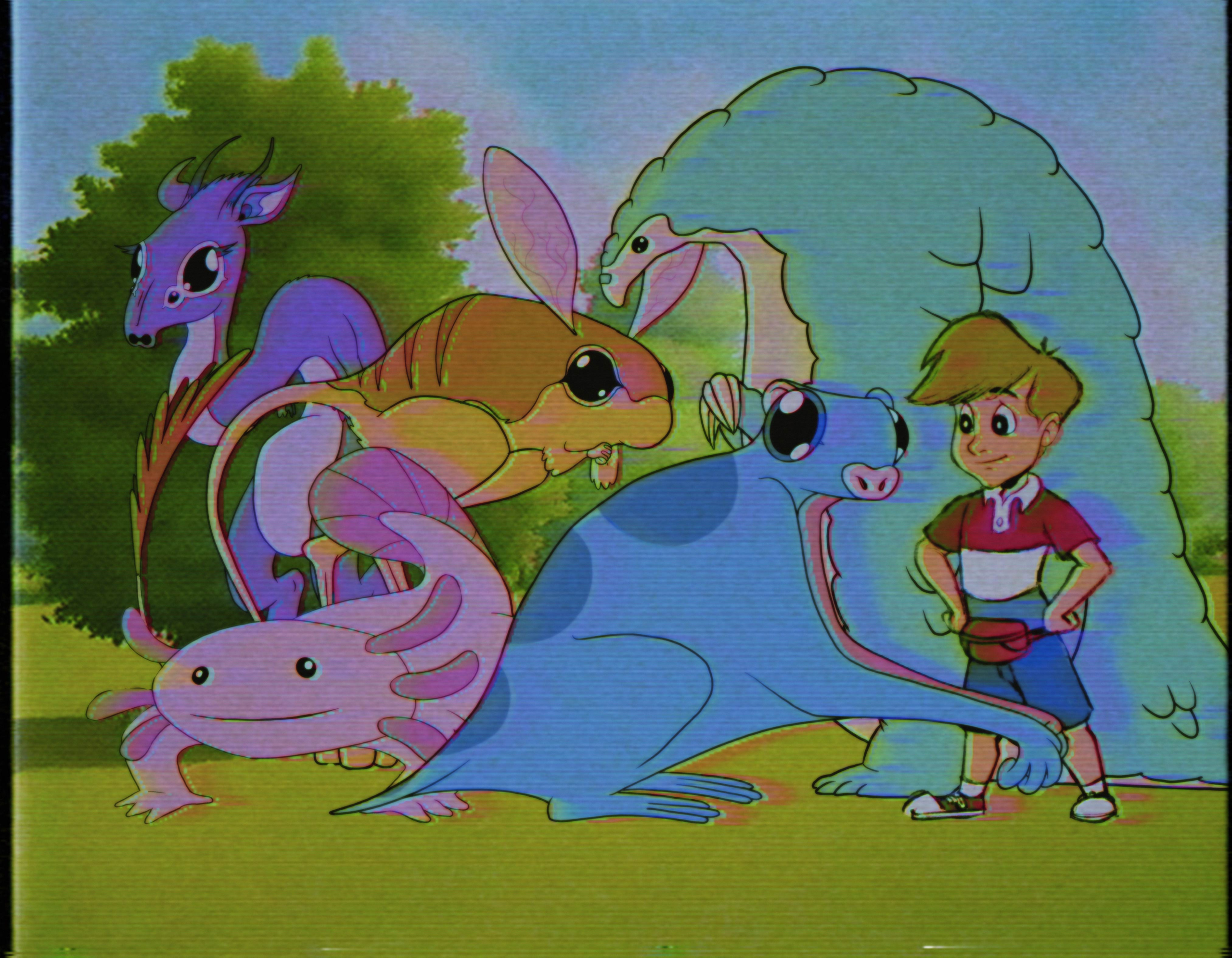
I wasn’t one of the first people to hear about Cenobears. I was actually pretty late to the whole phenomenon. When old episodes first started appearing online, I was still trying to catch up on the 500 other “must watch” television shows friends were recommending to me. Partially though, Cenobears escaped my notice because the show itself appeared in such an unremarkable way. Just a few episodes from a dedicated fan account, with no commentary besides a brief—usually comically understated—plot summary.
The cartoon was an episodic one with four kids–Andy, Jessica, Roger, and Mirabella–who would go on dimensions with this group of colorful, talking, animal creatures that came from some other world. The visual look was like the Smurfs or something, but the underlying lore felt to me like something out of H. P. Lovecraft. The episodes often ended with “lessons” that the kids supposedly learned, but if this were real life instead of a cartoon you could be pretty sure that what they were leaving the kids with was just lasting trauma.
Comments under the video and elsewhere online indicated that pretty much everyone who watched it had a vague recollection of the show from some time in their youth. Either they had seen it as reruns or it was a lesser known part of their Saturday morning routine. In fact, the show was even vaguely familiar to me, but I couldn’t have told you why at the time. Nobody seemed to agree on the decade however, and attempts to find the production company or other credits were unsuccessful. The only credit on the show was a simple “by Andrew Fouts” at the beginning and end. What everybody could agree on was that the show was weird. There were reaction videos and blog posts, all saying things like: “Wow! This was the stuff they used to have the balls to put on TV! Not like the snowflake stuff they put on for kids today.” Or, “I can’t believe our parents let us watch this stuff. #LatchKeyKids.”
Depending on who you spoke to, it was proof that the 80s were wildly free and unregulated as far as kids’ content went—back when parents smoked on the way to school and kids roamed the streets on their bikes until sunset. Or maybe it was a sign of how edgy the 90s were, or perhaps the 70s? Or perhaps everyone else was mistaken and it was an intentionally retro show from the 2000s or 2010s that everyone was misremembering. Studying clothing and hairstyles, or trying to examine the tape damage exhibited by the footage, gave conflicting conclusions and only served to inflame the debate in the nerdier corners of the internet.
By the time I started watching episodes, there was already a small but passionate fanbase. They maintained a message board where they traded fan theories and posted excerpts.
So of course, the first unusual thing I came across wasn’t something I found myself. A user named HugsBoson posted a scan of a ratty poster advertising a county fair that, seemingly coincidentally, had the same name as a county fair that featured in one of the episodes—episode 34, “The Cute One.” This caused some excitement on the board. Up until this point very little was known about the actual production of the show, and the account posting the episodes was rather consistent about not offering any useful information. Could this be proof that the show was made by someone originally from this town, Caney? Maybe this creator, Andrew Fouts, was dropping references to his own childhood as easter eggs. This dovetailed with another popular fan theory: that “Andrew Fouts” might have inserted himself into the show as the child character “Andy.” Detractors of this theory countered with the fact that “Andrew” is simply a common name. Supporters responded in turn that it’s highly unlikely a creator would accidentally give a character the same name as themselves, no matter how common the name was. Eagle-eyed readers were quick to point to anomalies in the county fair theory as well. There was in fact a town that went by the name Caney, but it had a population of only about 500 people, nowhere near large enough to host a fair. These internet sleuths posted google maps satellite photos of the town, revealing that the only field that existed anywhere within the town’s confines was much too small to host the sort of event shown in the episode. If the show was real, then perhaps this was just a case of a writer or cartoonist from a small town who made it big enough to memorialize their humble beginnings? Or if it was a hoax, this was likely where the hoax originator lived. But a town of less than a thousand people seemed like a highly unlikely locale to produce either of those. Some people joked that maybe the town had been larger at one point, until the events of the cartoon where most of the population–and land area, according to the episode—were made to vanish by the Cenobears. Maybe the cartoon was not an homage to Andrew Fouts’ hometown, so much as a documentary about its supernatural demise.

Curiously, HugsBoson seemed to take this line of thought much more seriously than all of the others joking about it. Whoever they were, they treated their investigation with the zeal of a true crime aficionado. This extended to them taking a flight to the town of Caney, which was coincidentally located only about 45 minutes north of me. They documented their trip with photos, including images of surveying equipment they brought with them. In the accompanying text, they explained that they had taken measurements at each corner of the park, and that according to their measurements, it was actually about one mile longer in each direction than it looked. Saying that it was larger than it appeared in satellite view would be enough to create the feeling of a thrilling coverup, but Hugsboson was arguing something crazier: that it was even larger than it appeared to the naked eye. This, they argued, made perfect sense if what was described by the characters in the show had taken place, and the space formerly occupied by the fair had been folded in on itself. This would mean that every time a person walked from one end of the park to the other, they were somehow skipping over an entire missing mile each time. I couldn’t make heads or tails of their surveying measurements, and I was pretty sure that there was a lot of room for error.Needless to say, fans of the show didn’t take the argument very seriously. But still, the dedication on the part of HugsBoson caught my attention.
I found myself weighing the plausibility of the argument despoite myself. The episode did use the phrase: “the world has healed up around them” to describe what happened to the missing fairgrounds in the episode. Following the in-universe logic, it would stand to reason that the county fair and all of the people attending were still there, just somehow… “folded up” in space. And it made sense—again, using in-universe logic—that you’d be able to “see” that fold somehow if so. I figured if something like that were to occur, it would be like someone had taken a piece of cloth, pinched a tiny section in the middle, and then tied a thread around just that tiny area. The remaining fabric would only be slightly smaller, but it would still appear mostly flat, aside from creasing near the site of the pinch. Though, that left hundreds of people unaccounted for, assuming we were going to take the episode at face value. They would in fact have to have been “forgotten” as the episode describes.
Another reason HugsBoson’s posts did not seem to attract much attention is because they had a frustrating habit of mixing fantasy with reality in their posts. Some posts were written from the expected standpoint of a curious, amateur investigator. But according to the dates on their posts, as time went on these were increasingly interspersed with bouts of creative writing, talking about their history watching the show as a young child, as well as peculiar, nonsensical, metaphysical rants making use of in-universe locations like the fantasy world the Cenobears were supposed to have come to Earth from. Much to my disappointment, the ratio of these types of posts shifted over time, until the final few posts where HugsBoson sounded like someone trying to type in the depths of an acid trip. Still, I decided to reach out.
I typed up a quick private message, expressing my respect for their work, followed by questions. Had they tried to see if an Andrew Fouts lived in Caney? And, struck by a sudden bout of inspiration, I added: “Actually, the town is probably full of Jessicas and Rogers as well, but how many Mirabellas could there be? Did you ask if anybody knows a Mirabella?”
No reply.
Around this time I had what, in retrospect, was one of my first “episodes.” Not episodes in the television show sense—episode in the “hallucinatory psychotic break” sense. Even now, it’s difficult to put into words, but one thing I saw reminded me of something I had read in one of HugsBoson’s more psychedelic posts. I found myself standing on what seemed to be a shore, or a beach, but in the most abstract sense. My mind was reading it as a beach, but visually the colors were too vibrant and bright, all purples and blues and reds, with sharp explosions of green and yellow as highlights. The “sand” against my feet was more sensation than anything else. Texturally it felt oddly fractal: if I looked downward at the shifting purple sands, it was as though I could see not only every individual grain, but also the detailed surface structure of each of them. Looking up to keep from being lost in that wasn’t much help. In front of me was a massive, multicolored ocean. Most overwhelming though was that each of those colors was an emotion I could feel. To look at it was to drown in a sea of involuntary feelings and impressions.

It would still be a while yet before I connected that experience to HugsBoson’s final posts. Even longer before I found the thread on the message board discussing similar experiences.
While waiting for the response from HugsBoson, I decided that Mirabella was a unique enough name that I might even be able to find information on it myself with a simple internet search. I didn’t have a last name, but I figured I could quickly sift through the limited list of possible candidates. Most of what I found in a more general search were names of things like companies, restaurants, and gated housing developments. But a social media search gave me about thirty accounts to choose from, most of which did not look at all like the little girl from Cenobears. So, I messaged the six faceless profiles.
The response from this came much faster than from my message to HugsBoson. I had a reply by the next day, and it read simply: “Yes, somebody made a show about my fucking life. It isn’t funny and it isn’t fun. You people don’t realize how dangerous this is. You need to stop watching. Now. Stop watching, stop sharing, and stop spreading this.”